
What Warren Buffett Taught Me About Content Strategy in Quiet Seasons
“Be fearful when others are greedy, and greedy when others are fearful.” – Warren Buffett
This quote is usually reserved for the stock market, but let’s be real—it applies to business visibility and content creation too.
When everything feels quiet… when engagement dips… when the algorithm ghosts you and everyone starts pulling back, going silent, and rethinking their strategy—that’s when most people disappear.
But what if those “quiet seasons” are exactly when the best momentum is built?
When Fear Creeps In (and What Most People Do)
In business, fear looks like:
- Slowing down because “people aren’t engaging”
- Waiting for the “perfect time” to launch
- Holding back content because “no one’s listening right now”
- Thinking, “I’ll post again once I have something exciting to share”
The instinct is understandable. When the room feels empty, we wonder if we’re talking to ourselves. We start to shrink back.
But visibility isn’t about speaking only when people clap. It’s about showing up when others don’t—and building trust while everyone else is waiting.
What Warren’s Quote Really Means for Creators and Founders
“Be fearful when others are greedy…”
This part is about caution when the market is hot. For creators, it’s a reminder to be discerning when everyone is chasing the same trends, the same tactics, the same viral moment.
“…and greedy when others are fearful.”
This is the good part. When the buzz dies down? When the feed goes quiet? That’s your moment. It’s when there’s more room, more attention, and more opportunity for you to show up with something grounded and generous.
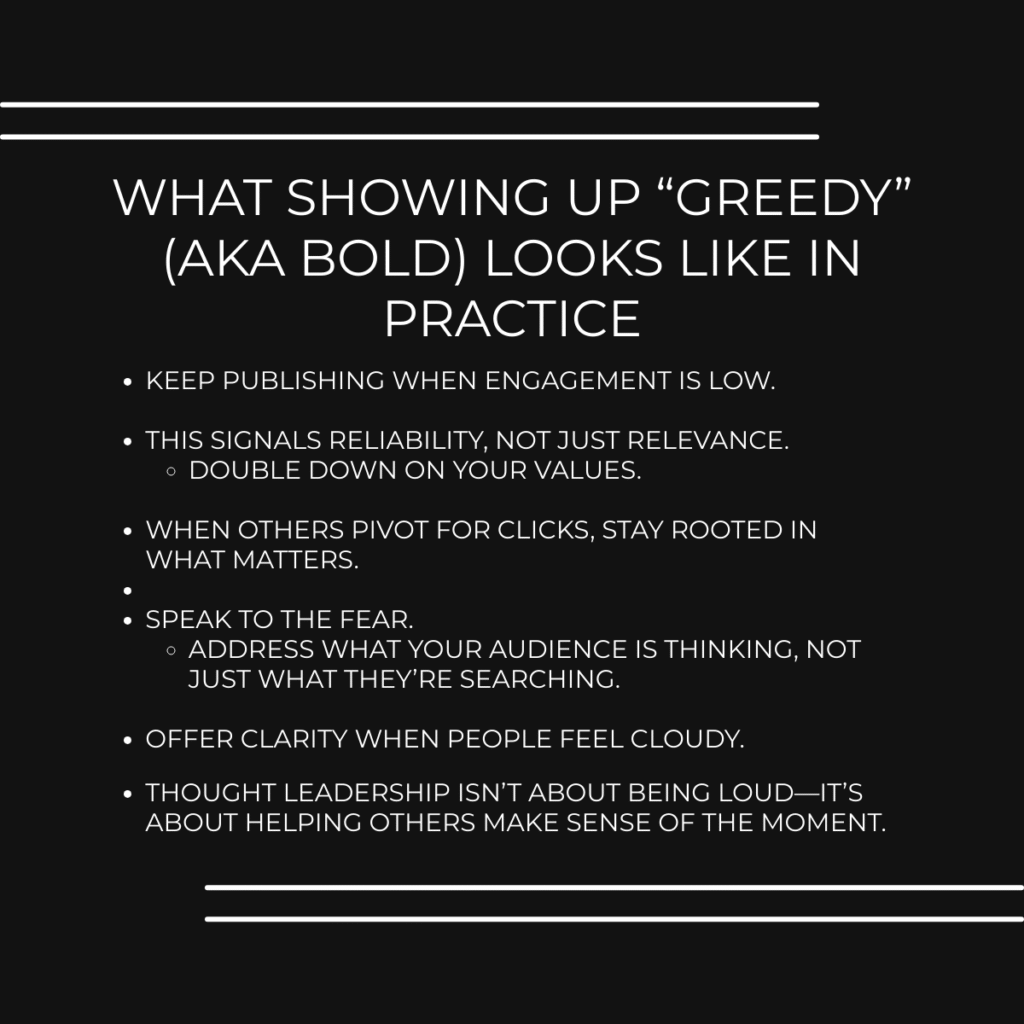
What Showing Up “Greedy” (aka Bold) Looks Like in Practice
- Keep publishing when engagement is low.
This signals reliability, not just relevance. - Double down on your values.
When others pivot for clicks, stay rooted in what matters. - Speak to the fear.
Address what your audience is thinking, not just what they’re searching. - Offer clarity when people feel cloudy.
Thought leadership isn’t about being loud—it’s about helping others make sense of the moment.
Sylvester Stallone and the Power of Holding the Vision
One of the most iconic examples of acting “greedy when others are fearful” comes from the story of Sylvester Stallone—and how he brought Rocky to life.
In the mid-1970s, Stallone was struggling. He was broke, had been rejected over 1,500 times by agents, and even sold his dog because he couldn’t afford to feed him. He had written the script for Rocky in just a few days after watching a fight between Muhammad Ali and Chuck Wepner.
But no one wanted to buy it—unless they could cast a big-name actor.
Stallone refused. He insisted on playing the lead role himself.
Studio after studio turned him down. They offered him upwards of $300,000 just for the script (a massive amount, especially for someone who was literally living in poverty).
He still said no.
Everyone around him was playing it safe. They were fearful: “No one will buy a boxing movie with a no-name lead.”
But Stallone was greedy in the Buffett sense—he saw the opportunity and bet on himself when no one else would.
Eventually, one studio relented. They gave him a tiny budget and let him star in the film. The rest is history.
Rocky went on to win three Academy Awards, including Best Picture. It launched a billion-dollar franchise. But none of that would have happened if he had followed the crowd or accepted the easy way out.
Stallone didn’t wait for the perfect moment. He created it.
What That Teaches Us as Creators
Most of us aren’t facing the kind of odds Stallone did—but we do face fear:
- Fear that no one will buy
- Fear that the algorithm hates us
- Fear that we’ll get it wrong
But that fear is often a signal that something important is about to happen. And when others step back? That’s when your voice has space to rise.
The Strategic Layer: How to Apply This to Your Brand
1. Keep showing up.
Even when things feel slow. Especially when they feel slow.
2. Reinvest in your message.
Don’t pivot because of panic. Refine. Recommit.
3. Look at what your audience is fearing.
Speak to their uncertainty. Be the voice of reason when the room goes quiet.
4. Create the thing you want to be known for.
Even if no one’s asking for it yet. (Rocky, anyone?)
🛠 Actionable Tip: Use This 3-Part Reflection Prompt
If you’re in a “quiet season,” use these questions to guide your next moves:
- What do I know to be true—even if the numbers don’t reflect it yet?
- What content or message am I scared to share (and why might that be important)?
- Where can I show up this month while others pause?
Choose one platform, one message, and one bold action. That’s your visibility play.
Quiet Seasons Aren’t Setbacks—They’re Strategy Windows
When others pull back, it’s tempting to do the same. But those are the exact moments that leaders, innovators, and visionaries lean in.
Visibility isn’t just about marketing. It’s about momentum.
So the next time you feel the fear—the temptation to go dark, to wait, to blend in—remember Stallone. Remember Buffett.
And remember this: What looks like risk is often just opportunity in disguise.
Need help building a strategic visibility plan that works in every season? Let’s map out a bold, human-first system that helps your brand stand out—even in the quiet.


